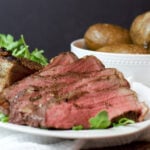
How to Reverse Sear Tri Tip
This Reverse Sear Tri Tip is slowly roasted with garlic herb compound butter, then finished in a hot skillet for a tender, juicy roast with a beautifully caramelized crust.
Servings 6 Servings
Calories 387kcal
Equipment
- 1 Sheet Pan with Rack
- Large Skillet Cast Iron or Stainless Steel
Ingredients
- 4 Tablespoons Butter softened
- 3 Cloves Garlic minced
- 1 Tablespoon Kosher Salt
- 1 Teaspoon Coarse Black Pepper
- 1 Teaspoon Fresh Rosemary minced
- 2.5 - 3 Pounds Tri Tip trimmed
- 1 Tablespoon Avocado Oil for searing
Instructions
- In a small bowl, combine the softened butter, minced garlic, kosher salt, black pepper, and fresh rosemary until well mixed to create a garlic herb compound butter.
- Pat the trimmed tri tip dry with paper towels. Spread the compound butter evenly over all sides of the roast. Let it rest at room temperature for 30 minutes before cooking, or season it up to 1 day in advance and refrigerate until ready to use.
- Preheat the oven to 250°F. Place the tri tip on a wire rack set over a sheet pan and roast until the thickest part reaches an internal temperature of 125°F using an instant-read thermometer.
- Remove the tri tip from the oven and let it rest for 20 minutes. During this time, the internal temperature will continue to rise about 5 degrees. The slow roasting process allows the fat to render gradually, while resting gives the juices time to redistribute throughout the meat for a tender, juicy roast.
- Heat a large cast iron or stainless steel skillet over high heat until it is very hot and just beginning to smoke.
- Add a thin layer of avocado oil, or another high smoke point oil, to the skillet.
- Place the tri tip in the skillet fat cap side down and sear for about 1 minute, or until a deep brown crust forms. If it takes longer than 2 minutes to brown, the skillet is not hot enough and the meat may begin to overcook.
- Turn the tri tip over and sear the second side for about 1 minute, or until nicely browned.
- Transfer the tri tip to a cutting board and slice into ¼-inch thick slices, cutting against the grain for the most tender bite.
Notes
Diana’s Tips for Success
Pat the tri tip dry with paper towels before rubbing the compound butter generously over the entire roast. Removing excess moisture helps the butter cling to the surface and promotes better browning later.
For the best flavor, allow the seasoned roast to rest at room temperature for about 30 minutes before cooking.
Begin checking the internal temperature about 20 minutes before the estimated finish time. Every roast is slightly different, so relying on a thermometer instead of the clock is the best way to avoid overcooking.
Always remove the tri tip from the oven about 5°F below your desired final doneness to account for carryover cooking. This is the additional cooking that occurs after the meat has been removed from the heat source.
Resting is every bit as important as the cooking itself. As the roast rests, carryover cooking will raise the internal temperature another five degrees while the juices redistribute throughout the meat. Cutting into it too soon allows those flavorful juices to escape instead of remaining where they belong.
If it takes more than two minutes to brown, your skillet isn't hot enough. The goal is to develop color quickly without continuing to cook the center of the roast.
How Long Does Reverse Sear Tri Tip Take?
Cooking time varies depending on the thickness of the roast rather than its exact weight, which is why an instant-read thermometer is far more reliable than the clock.
As a general guideline:
Begin checking the internal temperature about twenty minutes before the estimated finish time to avoid overcooking.
Internal Temperature Guide
For the most accurate results, remove the roast from the oven a few degrees before your desired final temperature.
Remember that the quick skillet sear adds very little additional cooking. Most of the temperature increase happens during the resting period.
How to Serve
Reverse seared tri tip is versatile enough for everything from a casual family dinner to a holiday meal. Pair it with roasted potatoes, grilled vegetables, a crisp salad, or your favorite steakhouse sides.
Can I Make Reverse Sear Tri Tip Ahead of Time
Tri tip is best served immediately after searing, but you can season it with the garlic herb butter up to 24 hours in advance. This gives the salt time to penetrate the meat while making dinner prep even easier the next day.
Tri tip is at its absolute best served fresh from the skillet while the crust is still crisp and the center is perfectly juicy.
However, the leftovers are delicious and can be used to make (insert links to quesadillas and tri tip sandwiches.
Storage and Reheating
Store leftover tri tip in an airtight container in the refrigerator for up to four days.
To reheat, warm slices gently in a skillet with a splash of beef broth or a small pat of butter over low heat. Gentle reheating helps preserve the tender texture without overcooking the meat
| Tri Tip Size | Approximate Cooking Time |
| Under 3 pounds | 1½ to 2 hours |
| Over 3 pounds | 2 to 2½ hours |
| Doneness | Remove from Oven | Final Temperature After Rest |
| Rare | 120°F | 125°F |
| Medium Rare | 125°F | 130°F |
| Medium | 130°F | 135°F |
| Medium Well | 135°F | 140°F |
| Well Done | 145°F | 150°F |
Nutrition
Calories: 387kcal | Carbohydrates: 1g | Protein: 39g | Fat: 24g | Saturated Fat: 10g | Polyunsaturated Fat: 1g | Monounsaturated Fat: 11g | Trans Fat: 0.3g | Cholesterol: 143mg | Sodium: 1323mg | Potassium: 620mg | Fiber: 0.1g | Sugar: 0.02g | Vitamin A: 236IU | Vitamin C: 0.5mg | Calcium: 53mg | Iron: 3mg